Hospitality: guests book what they have already seen.
Guests compare on portals but prefer to book direct — when they feel confident. A tour provides that confidence and leads from the room straight into your own booking system.
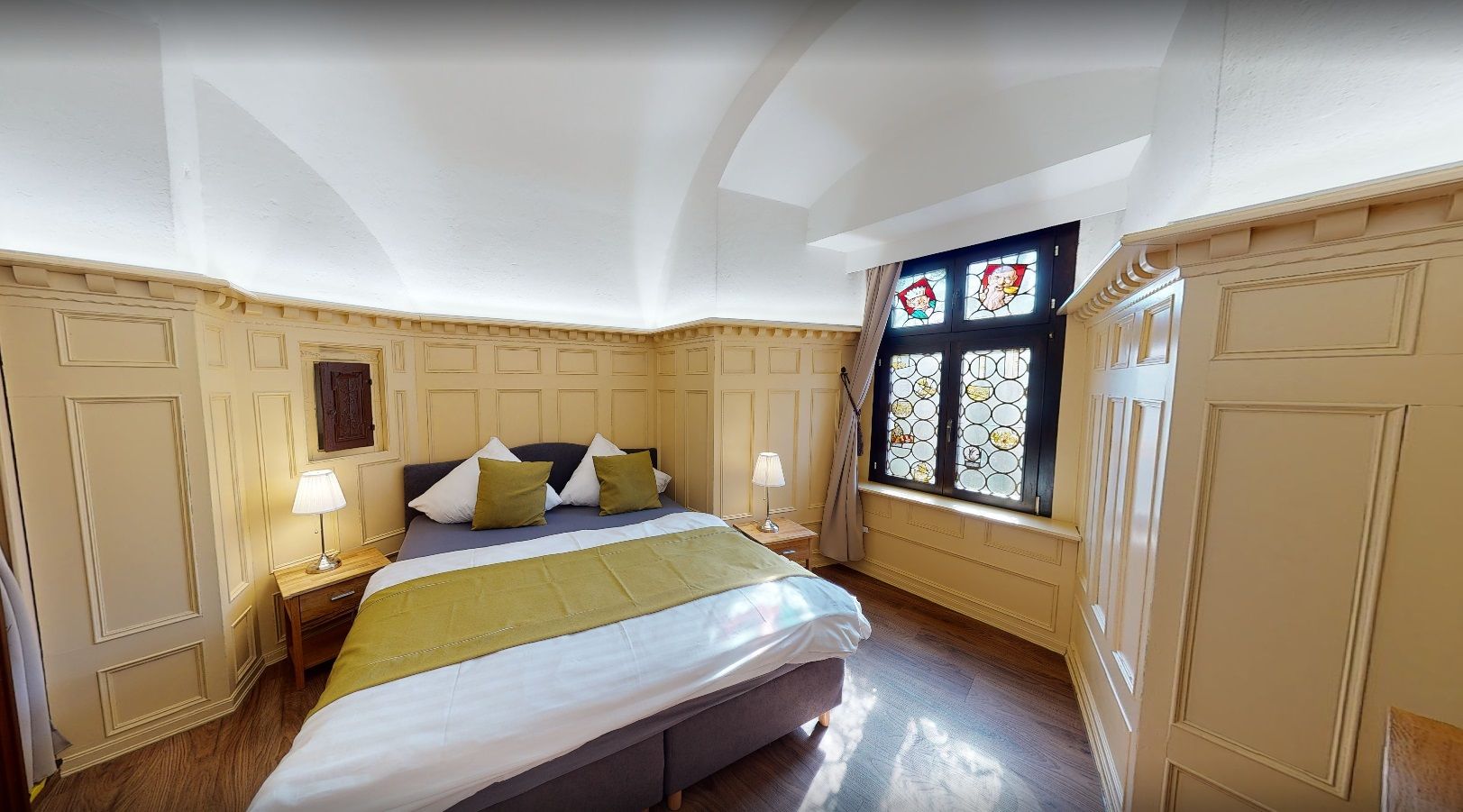
Guest room in the Goslarer Zwinger
A guest room in historic fabric: wood panelling, a vaulted ceiling and leaded glass windows. With rooms like this, guests book the character of the space too — the tour shows how light, materials and proportions work together.
What a tour achieves in hospitality
- Direct booking
Past the portal
Guests who have experienced your property in a tour land in your booking system via info points — with no commission to a portal.
- Trust
No surprises on arrival
Room size, view, bathroom: what was visible beforehand does not turn into complaints at reception or poor reviews afterwards.
- Meetings
Spaces planners can verify
Meeting planners want to know whether a room has daylight, whether it can be divided and how far it is to the break area and restaurant. With measurement and floor plan they check room sizes for themselves.
- Groups
For tour operators and group bookings
Anyone buying room allocations wants to know the property. A tour replaces the familiarization trip or prepares it.
In hospitality much is decided in a single moment: the switch from a comparison portal to your own website. If guests find nothing there but the same photos they already saw, they book on the portal — commission included.
A tour gives your site something no portal offers: the complete impression. And from there it takes the guest to your own booking system in one click.
What guests see in a hotel tour
The way from the entrance to reception, the lobby, breakfast room or restaurant, one sample room per category including the bathroom, plus spa, meeting rooms and outdoor areas. More important than any single image is how it all connects: how far the room is from the lift, whether the breakfast room has daylight, how big the bathroom really is. Wide-angle photos often make rooms look bigger than they are. A tour shows the proportions the way guests experience them on arrival, and the measuring tool lets them check whether a cot will still fit next to the bed.
From city hotel to holiday home
- City and conference hotels: meeting rooms, technical equipment and break areas. Planners get a picture in advance instead of travelling for every option.
- Leisure and spa hotels: spa, pool, relaxation areas and rooms with a view — the areas guests stay longer for.
- Guesthouses and inns: smaller properties that win people over with character rather than size, often in historic buildings whose layout is hard to grasp from photos.
- Holiday homes and apartments: for families and groups, the floor plan answers the most important question: who sleeps where? Info points can also explain house rules, arrival instructions or how to use the cooker and heating.
- Celebrations on site: for weddings and family parties, one tour shows the function room, terrace and guest rooms together, see also restaurants and bars.
- Accessible rooms: door widths, manoeuvring space and shower access can be shown and measured, instead of just being marked with a symbol.
From tour to booking
Info points in the room lead to the matching category in your booking system, in the restaurant to the menu, in the spa to the list of treatments. On the website a preview image is all it takes; the tour only loads when a guest clicks on it. As a link it fits into the booking confirmation, so guests find their way around more quickly on arrival, and into offers to conference clients and tour operators. With a Street View interior your property can also be seen in Google Maps — next to location, reviews and directions.
What matters during capture
Sample rooms are prepared as if for an arriving guest: beds made, curtains arranged so that the view and daylight come through, television off. Luggage, housekeeping trolleys and piles of linen stay out of sight, bathrooms are dry. In the lobby and restaurant, tidiness counts for more than decoration. Christmas decorations and other seasonal touches remain visible in the tour all year round — so only show what also works in summer.
Frequently asked questions
Your question is not listed? Ask us directly.
Do all room types have to be captured?
No, and it would not be sensible. The norm is one sample room per category, plus lobby, restaurant, spa and conference areas. That covers what guests want to see before booking.
How does this affect portal bookings?
Portals remain portals. The difference shows with guests who find you there and then visit your website — that is where a tour tips the decision towards direct booking.
When can you capture?
Ideally in low season or on days with low occupancy, so rooms are free and areas empty. We work area by area; operations continue.
Is it worth it for a single holiday let?
For high-end or unusual properties, yes — holiday homes with distinctive layouts, for instance. For a standard apartment good photos are usually enough; we will say so honestly.