Museums and cultural institutions: open even when closed.
A tour frees your institution from opening hours, travel distance and staircases. We have digitized World Heritage sites, town halls and exhibitions — from monuments to temporary shows.
Three landmarks in one project
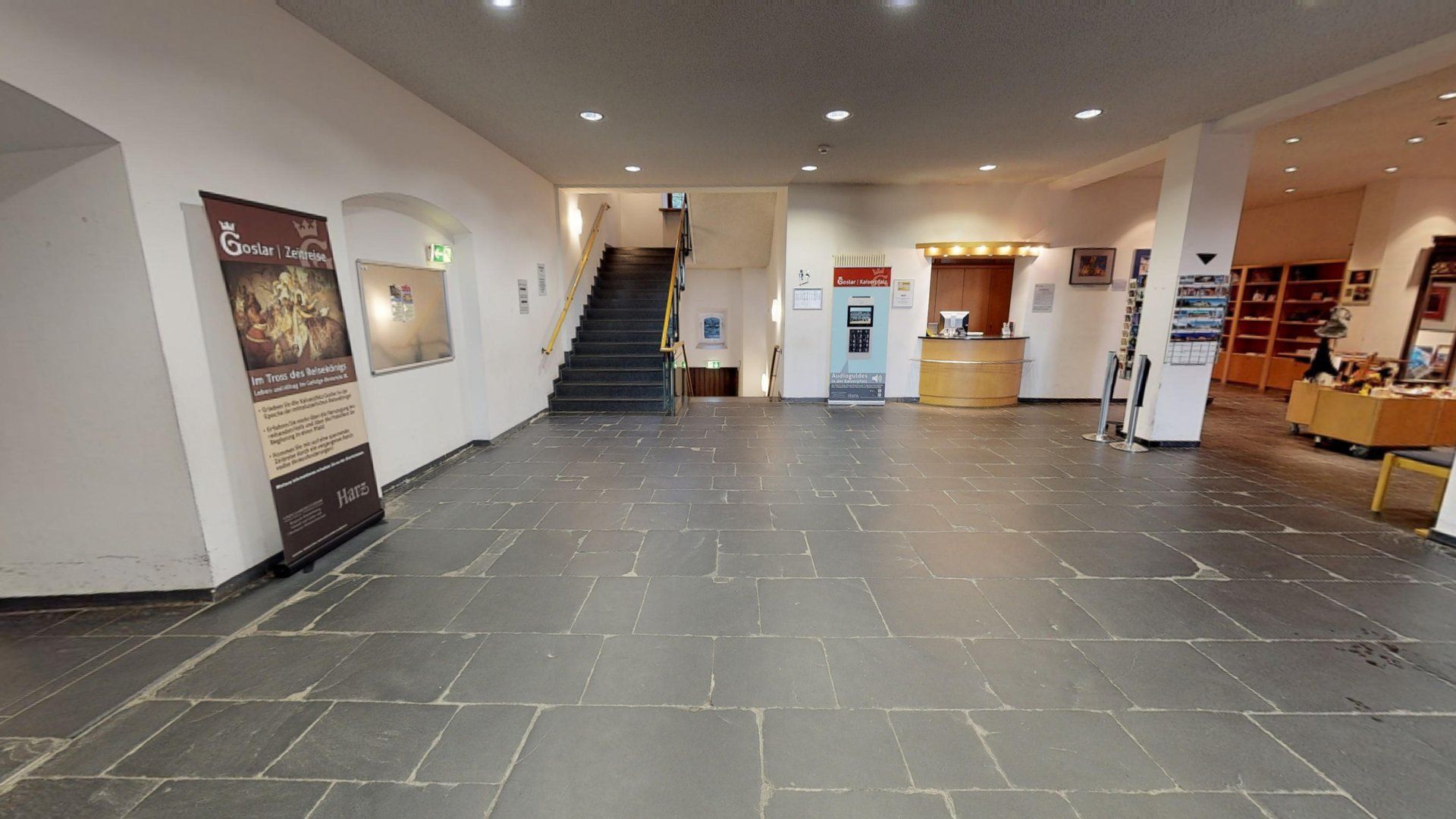
The Imperial Palace is part of a UNESCO World Heritage Site and one of the best-known secular buildings of the German Middle Ages. We captured it as a walkable tour — 3,429 m² over three days. The capture formed part of a joint project by the City of Goslar, Goslar Marketing GmbH and the Rammelsberg mining museum, which also covered parts of the Rammelsberg visitor mine and the Odeon theatre. The Odeon shows most clearly what this is about: there were about four days for the capture before the theatre’s interior was demolished.


What a digital twin delivers in the cultural sector
Museums rarely have a marketing problem and almost always a reach problem: those who cannot come see nothing.
- Reach
Visitors who would never have travelled
Interested people abroad, researchers, potential group bookers: a tour reaches people for whom travelling was never on the table — and turns some of them into real visitors after all.
- Access
Accessible without stairs
Historic buildings are rarely barrier-free. A tour opens upper floors, towers and narrow passages to people who cannot reach them physically.
- Insight
Beyond the barrier
Roof structures, mine galleries, storerooms: what is closed off for safety or conservation reasons can still be shown in the tour, without anyone having to go in. The dollhouse view also shows the entire building as a cut-away model.
- Teaching
Material for schools and universities
Teachers prepare excursions or replace them. With info points on exhibits, the tour becomes a learning medium that works without supervision.
- Exhibition planning
Planning on the model, not with a tape measure
Wall lengths, ceiling heights and doorways can be measured in the model, and floor plans are included. Anyone preparing a temporary exhibition can plan partition walls and display cases at the desk instead of taking every measurement on site.
- Record
Exhibition and fabric preserved
Temporary exhibitions disappear; buildings change through refurbishment. A scan preserves one day’s state — on request to the millimetre as a laser scan.
Cultural institutions face a double pressure: to reach more people while preserving their holdings. A 3D tour serves both with a single capture — it is shop window and documentation in one.
Outreach, guided tours, hire
For learning and outreach, the tour is more than a preview. Info points with text, images or links to further material can be placed on exhibits and rooms. The model thus becomes a medium with which school groups prepare a visit and interested people explore a topic the exhibition can only touch on. Guided tours benefit too: showing the virtual tour before or afterwards lets the guide cover rooms that the group does not enter.
For theatres and cinemas, something else often comes first: auditoriums, foyers and stages that are also hired out for third-party events. Anyone who sees the seating, stage dimensions and side rooms in the tour beforehand makes a more specific enquiry. The site visit then becomes a matter of detail rather than first orientation. In a cinema, the tour also shows how the screen and the rows of seats relate to each other.
Historic buildings: choosing the moment
With historic buildings a further point arises: what is recorded today survives, regardless of what refurbishment, weather or time do to the original. For heritage conservation and building research, that is often a stronger argument than visitor numbers. Timing is decisive: before a refurbishment, a change of use or the dismantling of an exhibition, the capture is often the last opportunity to record a state completely.
For outreach and visitor information, a Matterport tour is usually enough. Where building researchers and conservators need exact geometry, for deformation analyses or refurbishment planning for example, a laser scan complements the capture with an accuracy of 1.9 mm at 10 m.
Frequently asked questions
Your question is not listed? Ask us directly.
Doesn’t a virtual tour replace the real visit?
Experience says otherwise. A tour shows rooms, fittings, light and the sense of space, but not the experience on site: no guided tour, no voices in the hall, no original right in front of you. In practice it works like a shop window: people are more likely to visit when they can see what awaits them — and those who genuinely cannot come would not have come anyway.
Are we allowed to show exhibits digitally?
For your own holdings, usually yes. For loans and works under copyright, digital reproduction rights need to be cleared — this mainly concerns modern art. We can exclude individual areas or objects on request; that is technically straightforward.
What about visitors in the images?
The simplest approach is to capture outside opening hours, when nobody is in frame.
Can we use the tour for funding applications?
Yes, and that is more often the trigger than you might expect. With an existing tour, applications for digitization and outreach projects become far more concrete — it serves as both evidence and working basis.
How long does capture take during normal operation?
That depends on floor area, layout and fittings, which is exactly what we look at during the walkthrough. Larger institutions are captured area by area, ideally in the mornings before opening or on closing days, so that operations are not disrupted.